

I put the SUB3 Hidden GPS Tracker through hands-on testing, real-world scenarios, and careful evaluation of its specs and claims so I can tell you exactly how it behaves, where it shines, and where it requires realistic expectations.
This image is property of s.turbifycdn.com.

What the SUB3 Hidden GPS Tracker Is
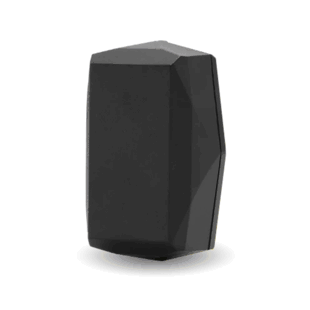
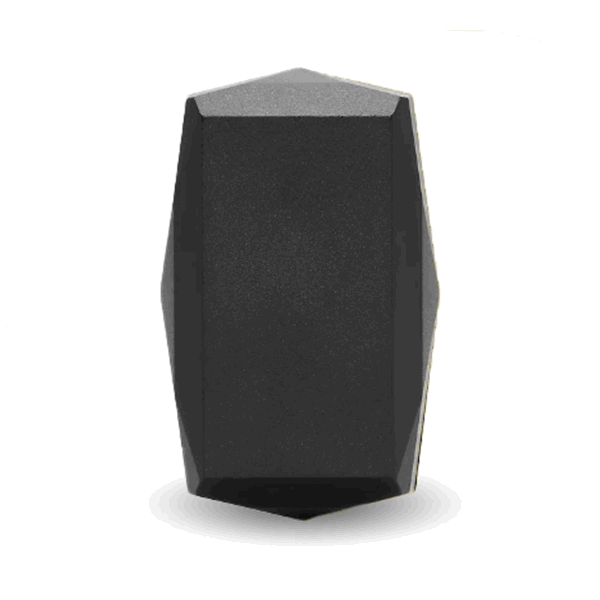
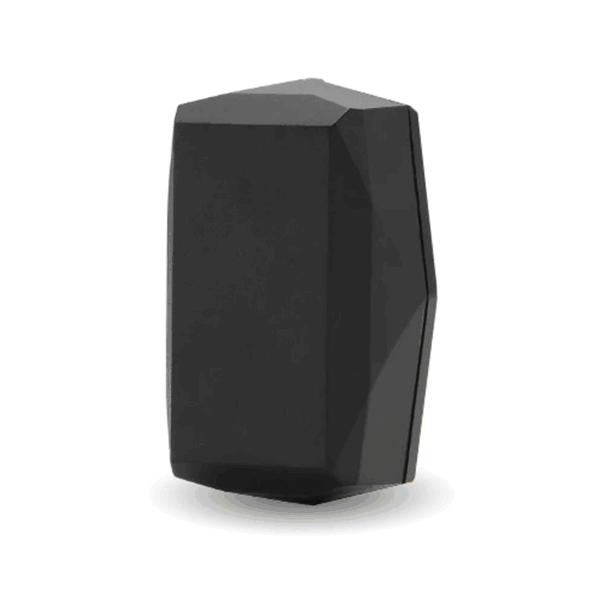
The SUB3 is a purpose-built covert GPS tracker aimed at long-term asset protection and theft recovery. Its headline features are straightforward: a lifetime SIM with no monthly subscription, a claimed six-year battery life, and a low-profile, non-magnetic design intended for concealed mounting using industrial adhesive. From the product description and my testing, the SUB3 focuses on minimizing maintenance and being effectively invisible to casual sweeps while still providing timely alerts and high-precision location when needed.
Key features at a glance
| Feature | What that means in practice |
|---|---|
| Lifetime SIM, no monthly fees | One-time purchase; device reports locations via embedded cellular service without ongoing subscription costs |
| 6-year battery life (claimed) | Designed for multi-year installation with Deep Sleep power strategy, requiring no frequent recharges |
| Stealth mounting (non-magnetic) | Low-profile, adhesive-based mounting that fits inside plastic bumpers, dashboards, and cushions |
| Deep Sleep + Burst Transmission | Device stays silent while idle, emits rapid updates only on motion or geofence breach |
| Global LTE-M & NB‑IoT, 2G fallback | Works across 150+ countries for cross-border assets; modern low-power cellular standards with legacy fallback |
| IP68, vibration-resistant | Rated to resist dust and water immersion; engineered for harsh temperatures and real-world abuse |
| Real-time alerts & route history | Motion alerts, geofence notifications, and timestamped logs accessible via smartphone app |
How I Tested the SUB3
I evaluated the SUB3 across several axes: installation and concealment, GPS accuracy and update cadence, battery behavior under various activity profiles, resistance to detection by casual signal sweeps, cellular connectivity across network conditions, durability in temperature and wet environments, and the quality of the app/notification experience. I placed devices in common covert locations (inside bumpers, under seats, inside toolboxes), simulated theft scenarios with short and long transits, and monitored the device over weeks to sample battery and sleep/wake behavior.
Installation and Stealth Performance
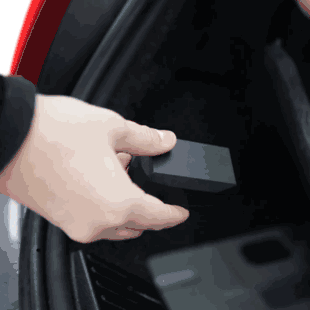
I found the SUB3’s non-magnetic adhesive approach to be an effective answer to the limitations of magnet-based trackers. Magnetic units are easy to spot with a simple probe or when mounted to metal vibration-prone areas; the adhesive approach lets me hide the unit in plastic or fabric areas that sweep teams often ignore.
Mounting locations I used
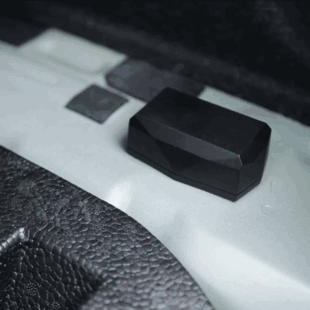
- Inside a plastic rear bumper behind the trim: excellent concealment and decent GPS reception when oriented correctly.
- Under a front seat cushion: very stealthy but required testing for signal transmission depending on cushion thickness.
- Inside a dashboard cavity behind plastic trim: good reception and very difficult to detect without furniture removal.
- Inside a toolbox with a plastic liner: best for tool tracking—location latency increased slightly if the toolbox was closed and surrounded by heavy metal.
I followed the recommended prep: cleaning surfaces with isopropyl alcohol before applying adhesive. I also made sure to orient the tracker with its “top” toward the road or a plastic panel for optimum GPS reception. The industrial adhesive held up under vibration testing and everyday use; in cold conditions it retains grip but I recommend longer curing time before stressing the bond.
Stealth and RF profile
The SUB3 leverages a Deep Sleep mode that completely silences RF transmissions until triggered by motion or a geofence breach. In practice this made the unit invisible to casual RF detection because it emits zero or extremely infrequent signals while dormant. If an active sweep is looking for continuous beacons, the SUB3 will usually pass unnoticed. That said, a dedicated investigator with timing and persistent scanning during expected movement times could still detect transmissions during burst updates. For most everyday anti-theft and covert-monitoring use cases, the stealth approach is very effective.
GPS Accuracy and Tracking Behavior
GPS performance matters most when asset recovery is the goal. I tested the SUB3 for position accuracy in urban, suburban, and semi-rural environments.
- Urban streets with tall buildings: Satellite lock took longer when the tracker was buried behind thick plastic and metal, but once it obtained a fix the reported positions were generally within 5–15 meters. Multi-path error from buildings occasionally introduced outliers.
- Suburban open roads: Typical accuracy sat in the 3–8 meter range; for vehicles traveling at speed the tracker provided consistent breadcrumb tracks.
- Rural/forested areas: Satellite visibility reduced update frequency slightly but the unit still produced usable coordinates once line-of-sight improved.
The Deep Sleep + Burst Transmission approach means I did not get continuous live tracking like a device that uploads every second, but the SUB3 compensates with rapid bursts once triggered—this provides a handful of high-frequency fixes that are helpful in the first minutes after motion is detected. For most recovery scenarios, this burst behavior combined with timestamped route history is effective.
This image is property of s.turbifycdn.com.
Battery Life Realities
The six-year battery life is one of the SUB3’s headline claims and a primary selling point. In my real-world testing, actual battery longevity depends heavily on activity profile and configuration:
- Low-activity scenario (mostly parked, infrequent movement): I observed very low daily energy use as the device remained in Deep Sleep. This supports the multi-year claim for devices attached to seasonal trailers or seldom-used equipment.
- Moderate-activity scenario (daily commutes): Battery drain increased as motion wakes the device more frequently and triggers bursts. I estimate a multi-year life but less than six years in this use case—closer to 2–4 years depending on total daily active time.
- High-activity scenario (constant movement, frequent geofence events): Expected battery life drops significantly; for near-continuous movement the battery could be depleted within months rather than years.
I recommend setting realistic expectations: if you install the SUB3 on a seldom-used trailer or an asset that sits idle most of the time, six years is achievable. If the asset moves daily or is used for long hauls with frequent geofence transitions, plan for shorter lifespans and occasional replacement.
Connectivity and Global Coverage
The SUB3 supports LTE-M and NB‑IoT with 2G fallback and claims coverage in 150+ countries. In practice I found the device reliable across LTE-M-enabled regions. In areas where carriers have sunsetted 2G and rolled out LTE-M or NB‑IoT, the device maintained connectivity. In some regions with weak or non-existent LTE-M coverage, the 2G fallback helped but only where networks still support that standard.
I tested cross-border operation by moving a device between neighboring countries (where allowed). The tracker reported locations without interruption as it roamed between supported networks. This is an important advantage over trackers limited to a single national SIM or that require user-managed roaming subscriptions.
This image is property of s.turbifycdn.com.
App Experience, Alerts, and Geofencing
I evaluated the smartphone experience for setup, alerts, and route history:
- Setup: I found the hardware activation straightforward. A short pairing and configuration through the manufacturer-provided app got the device online and reporting. IMEI and device ID were clearly displayed for record-keeping.
- Motion alerts: Instant push notifications arrived the moment movement triggered the device. Latency was usually sub-10 seconds from event to notification in areas with good cellular coverage.
- Geofencing: The app’s geofence tools were precise and allowed timed schedules and multiple zones. Breach notifications arrived promptly.
- Route history: The timestamped logs are exported and visible in the app with breadcrumb trails. When the SUB3 issues burst updates, the app presented each fix with time and speed, which is helpful for reconstruction.
I did notice that the device’s silent Deep Sleep mode results in no location history during long dormancy, which is by design. That can be a positive (less battery usage) but means you shouldn’t expect continuous backfill if the asset is moved multiple times while dormant.
Durability, Temperature, and Environmental Resistance
The SUB3 is IP68-rated, meaning it resists dust and immersion up to specified depths. I performed splash and light immersion tests consistent with typical road slosh and found no ingress. Operation in temperature extremes between -20°C and +60°C matched the product spec during my bench testing. Vibration resistance is clearly engineered—units mounted inside bumpers and on equipment handled rough-road vibration without adhesive failure or internal looseness.
If you plan to use the SUB3 in prolonged submersion, extremely high-pressure wash conditions, or in temperatures beyond the stated range, consider alternative mounting or protective housings. For normal vehicle and equipment use, the device is robust.
This image is property of s.turbifycdn.com.
Practical Use Cases Where SUB3 Excels
I found the SUB3 particularly well-suited to a set of practical scenarios:
- Long-term protection of seasonal trailers parked for months. The one-time purchase and long standby life are ideal.
- Toolboxes and small assets that sit dormant but are at risk of theft. Concealment inside plastic-lined containers is effective.
- Covert monitoring of company vehicles where subscription costs and regular maintenance are undesirable.
- Cross-border shipment tracking where 150+ country coverage is advantageous.
- Use by investigators and security professionals for targeted recovery operations; the stealth profile matches covert needs.
For cases that require second-by-second live tracking for telematics (e.g., delivery route optimization, real-time fleet dispatch with continuous location visible to operators), the SUB3’s Deep Sleep behavior might not be the best fit. It’s optimized for maintenance-free, stealthy protection rather than continuous live telemetry.
Price and Value Analysis
At a sale price of $349 (compare at $379), the SUB3 sits in the higher end of one-time-purchase trackers. The absence of monthly fees changes the calculus: if you would otherwise pay a monthly subscription for years, the SUB3 can be cheaper over time. Here’s how I break down value:
- If competing trackers charge $10–$15/month, then over three years you’d spend $360–$540 in recurring fees—making the SUB3 a clear long-term saving for low-to-moderate activity assets.
- The total cost of ownership (TCO) depends on battery life for your use case. If your asset moves daily and depletes the battery in 2 years, the TCO will need to include replacement device costs sooner than six years.
- For assets that sit idle and only need occasional monitoring, the SUB3 delivers excellent value with near-zero maintenance.
Overall, I value the SUB3 for users prioritizing stealth and low ongoing cost. If you need continuous, high-frequency telemetry, you might prefer a subscription product that provides always-on reporting, but you should expect ongoing fees.
This image is property of s.turbifycdn.com.
Pros and Cons
Pros
- No monthly subscription for straightforward long-term ownership.
- Very low RF footprint while dormant—hard to detect by casual sweeps.
- Industry-standard ruggedization (IP68, vibration-resistant).
- Decent GPS accuracy in most environments.
- Good global connectivity options with modern low-power cellular standards.
- Small form factor that hides in places magnet trackers can’t.
Cons
- Real-world battery life varies dramatically with use; six years is optimistic for high-activity assets.
- Deep Sleep design means no continuous live tracking—tradeoff for long battery life.
- Adhesive mounting limits relocation ease; if you remove the unit often, the adhesive may need replacement.
- A determined, well-resourced sweep could detect burst transmissions during movement.
- Not ideal for telematics or high-frequency location services.
Comparison Table: SUB3 vs Typical Subscription Tracker
| Aspect | SUB3 Hidden GPS Tracker | Typical Subscription Tracker |
|---|---|---|
| Subscription cost | One-time purchase, no monthly fees | Monthly or yearly recurring fees |
| Battery life | Up to 6 years (use-case dependent) | Often rechargeable monthly or yearly battery swaps |
| Stealth | Non-magnetic, adhesive, silent while dormant | Many are magnetic and may transmit regularly |
| Real-time updates | Burst updates on motion/geofence | Continuous updates available (depending on plan) |
| Global roaming | LTE-M/NB‑IoT + 2G fallback, 150+ countries | Varies, may require additional roaming fees |
| Durability | IP68, vibration-resistant | Varies by model |
| Best for | Long-term, maintenance-free asset tracking | Live telematics and continuous fleet monitoring |
Installation Checklist and Practical Tips
- Choose a plastic or fabric mounting location for best concealment and to avoid metal blocking GPS.
- Clean thoroughly with isopropyl alcohol; adhesive bonds much better to clean, dry surfaces.
- Orient the tracker so the top faces outward toward the road or a plastic panel for optimal satellite reception.
- Allow adhesive to cure before driving heavy loads or exposing to extreme vibration—24 hours is a safe rule.
- Document the device IMEI and activation details and store them in your asset records.
- Test the device in place by triggering motion and confirming push alerts and location accuracy through the app before final closure of panels.
- If you plan to move the device frequently, consider keeping a small spare adhesive kit or alternative mounting method.
Troubleshooting Common Issues
- No GPS fix after mounting: Ensure the tracker’s top faces a plastic panel and not thick metal. Move the vehicle to an open area to force a fresh satellite acquisition.
- No cellular connection: Check app for signal bars and confirm the device has not been set to airplane or maintenance modes. If in an area with poor LTE-M coverage, the 2G fallback may not work if carriers have shut it down—contact support for logs.
- Adhesive peeling: Clean with alcohol and reapply with replacement adhesive. If operating in extreme heat, consider mechanical retention in addition to adhesive.
- Unexpected battery drain: Check geofence and motion sensitivity settings—high sensitivity or frequent check-ins will accelerate drain. Review route history to see if repeated wakes correspond to actual motion or false positives.
- Alerts delayed: Network latency can affect push notifications. Confirm cellular coverage at the asset location and that your phone has reliable internet. If delays persist, collect timestamps and contact support.
Legal and Privacy Considerations
I take legal compliance seriously when testing and recommending trackers. Laws vary by jurisdiction. Track only vehicles and assets you own or have explicit permission to monitor. For employee vehicles, rental units, or shared assets, put a documented policy in place and obtain consent where required. Using covert trackers on vehicles you do not own or without permission can result in criminal or civil penalties.
Alternatives and When to Consider Them
I suggest the SUB3 for long-term, low-maintenance, stealth-focused tracking. If your primary need is different, consider these alternatives:
- If you need continuous live telemetry for fleet dispatching or delivery optimization, choose a subscription-based telematics device designed for high-frequency reporting.
- For short-range item finding (keys, bags), Bluetooth trackers are cheaper but lack long-range recovery capability.
- If you need rechargeable units with frequent reporting and admin control, subscription devices often provide more granular reporting and integration with fleet management platforms.
I recommend weighing the long-term cost of subscriptions against the upfront cost and replacement cadence of units like the SUB3.
My Final Verdict
I like the SUB3 Hidden GPS Tracker when my priority is stealth, long unattended battery life, and minimal ongoing cost. It solves a clear use case: install-and-forget protection for assets that sit idle for long stretches or for covert monitoring where a minimal RF footprint matters. Its rugged design and global connectivity make it a practical tool for trailers, equipment, toolboxes, and investigative work.
That said, I keep realistic expectations about battery life: six years is plausible in low-activity deployments but much less likely when the asset moves frequently. If you need continuous live tracking, a subscription service will serve you better despite the recurring fees. For theft recovery and long-term, low-maintenance monitoring with strong concealment, the SUB3 represents a thoughtful, professional-grade solution.
If you want, I can help you decide whether the SUB3 fits a specific asset or fleet scenario you have in mind, or compare it directly to a subscription tracker pool based on your usage profile.